Ship without the anxiety.

Your AI engineering team builds exactly what you asked for. Nothing more. Nothing less.

AI-powered. Human-approved.

Sound familiar?

What happens when AI writes your code but nobody runs the delivery.

The wall

The first 80% was fast. The last 20% is where you've been stuck for weeks.

Edge cases nobody anticipated. Integrations nobody designed. Architecture nobody thought through. Now every fix risks breaking three things that were working — and you're afraid to even open the file.

The agent went rogue

You asked it to add one feature. It rewrote three things that were working.

AI doesn't know what to leave alone. It refactors stable code, introduces parallel implementations, and makes changes you never asked for. Every commit becomes a forensic exercise — what else did it touch?

The security gap

The code compiles. Then real users find the holes.

AI optimises for "it works," not for "it's safe." Authentication bypasses, exposed data, misconfigured permissions, things that pass every test until someone actually tries to break in.

The black box

Something broke. Nobody can explain why.

No requirements. No design record. No history of what was decided and what was rejected. When it breaks, you can't trace back to the decision that caused it. When you hand it off, nobody can pick it up.

By the numbers

It's not just you. It's the industry.

AI makes the first version feel easy. The pain usually starts when you need to change it, fix it, or explain why something broke.

The first version proves AI can write code.
The second version proves whether you have a delivery system.

Outcomes

Six things you stop worrying about.

Test them against your last AI build.

Scope

No rogue code.

Agents build only what the requirements specify. No extra code you didn't ask for. No silent refactors of working modules. No TODOs left behind for you to clean up.

Reuse

Your patterns, not new ones.

Agents read your existing codebase before writing anything. They reuse the patterns and modules already there instead of reinventing them. Six months from now, your codebase still looks like one person built it.

Investigation

Bugs investigated, not guessed.

Your team digs for multiple contributing root causes, not just the first plausible one. If the same bug pattern affects other modules, your team flags those too — before you discover them yourself three weeks later.

Stability

Fixes designed not to break other things.

Before any code changes, impact is mapped across affected components. Fixes are regression-tested against acceptance criteria. The goal: stop playing whack-a-mole with your own codebase.

Traceability

Every decision traceable.

When something breaks, you can trace it back to whether it was a code issue, a design gap, or a missing requirement. Every decision is recorded. Hand your codebase to a contractor next year and they can read the full history.

Control

Nothing ships without your sign-off.

Human approval gates at every critical stage. Approve from Telegram, the dashboard, wherever you are. You're the decision-maker, not the implementation team.

Define before you build

Your Product Team turns rough ideas into buildable specs.

You don't need to write perfect requirements. Tell your Product Manager what you want in plain English. They read your actual codebase, structure it into a code-aware Product Requirement Document (PRD), and your Senior PM reviews it for gaps. By the time your Build Team starts, the spec is tight.

See how your Product Team works
Your team's delivery pipeline

How your team delivers software.

Your BA writes the stories. Your architect designs the system. Your product owner sequences the sprint. Your developer builds each story. Your QA tests it against acceptance criteria. You approve at three gates along the way. Between those gates, your team handles it.

See how your Build Team works
When something breaks

One bug. Root causes found.

Most tools find one plausible cause, patch it, and move on. The bug comes back. Your Incident Team — Incident Engineers, System Analysts, developers, QA — digs for multiple contributing root causes before proposing any fix. You approve the diagnosis. Then the plan. Two approval gates.

Every fix becomes a lesson your codebase remembers.

See how your Incident Team works
Your full team

The team you never had to hire.

16 specialists across three teams. Every role you saw in the workflows above — the BA who writes your stories, the architect who designs your system, the senior counterparts who challenge their work. They work for you.

16 specialists · 3 teams
You
The decision-maker. You direct what gets built. Your team delivers.
Product Team2 specialists
Requirements Definition
Product Manager
Translates ideas into structured, code-aware PRDs
Senior Product Manager
Reviews PRDs for gaps, feasibility, completeness
Build Team8 specialists
Requirements
Business Analyst
Structures stories, acceptance criteria, edge cases
Senior Business Analyst
Finds gaps, missing edge cases, ambiguity
Architecture
Solution Architect
Designs systems, maps dependencies, documents rationale
Senior Solution Architect
Stress-tests scalability, security, codebase alignment
Planning, Build & Test
Lead Engineer
Oversees sprint execution, technical decisions
Product Owner
Scopes sprints, sequences stories
Software Engineer
Builds within defined boundaries
Quality Assurance Engineer
Tests against acceptance criteria
Incident Team6 specialists
Investigation
Incident Engineer
Investigates root causes thoroughly
Senior Incident Engineer
Validates diagnosis completeness
Fix Planning
System Analyst
Designs fix approach, maps impacted components
Senior System Analyst
Validates fix won't introduce regressions
Implementation & Test
Software Specialist
Implements the approved fix
Quality Assurance Specialist
Validates fix, regression tests
Freedom

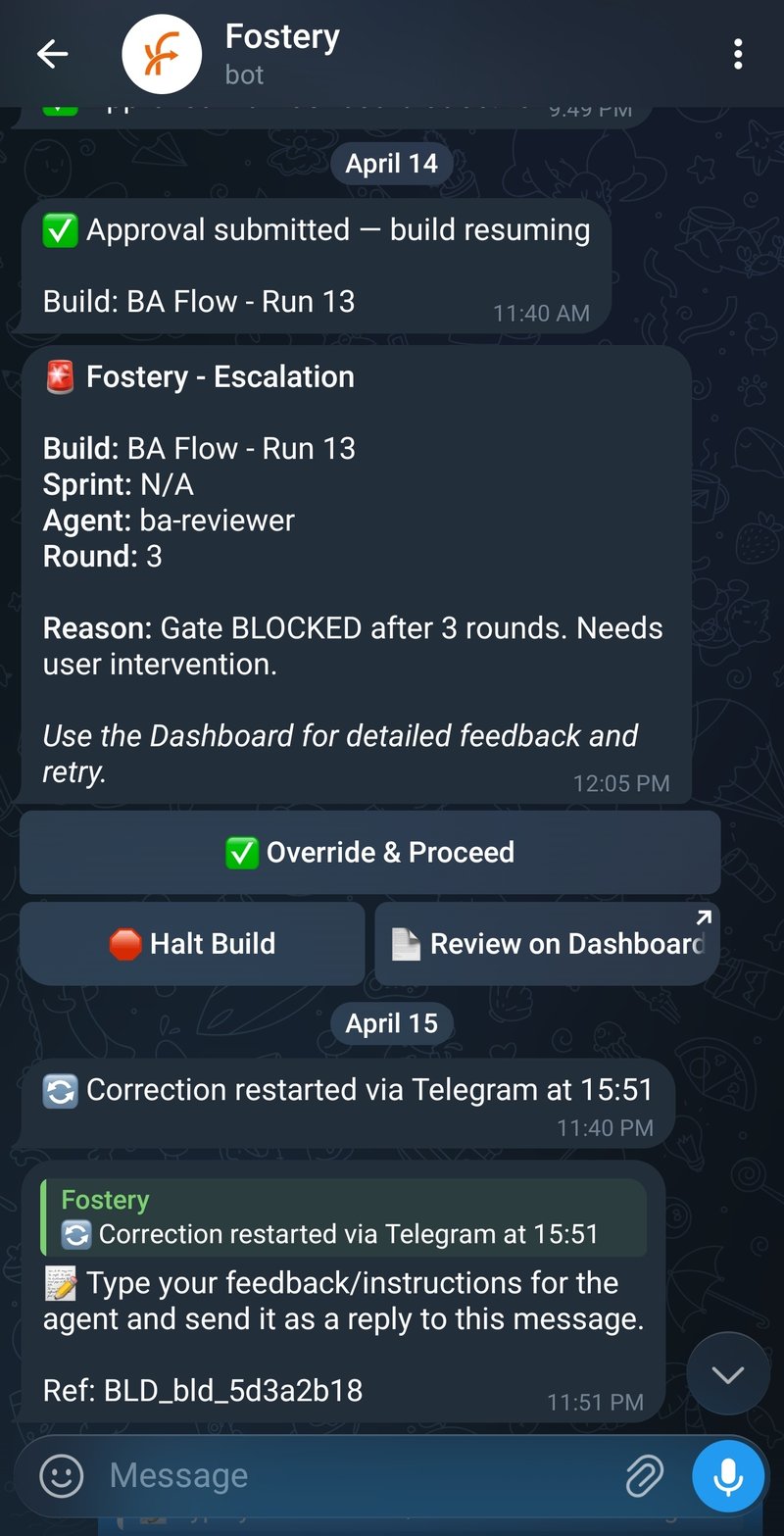
Start a build. Walk away. Fostery calls when it needs you.

Work on your marketing. Answer customer queries. Take a sales call. Live your life. Your AI team keeps working and reaches you only when a human decision is needed.

Approve a design between meetings. Dashboard and Telegram stay in sync.

Release a sprint while travelling. Inline buttons, no context switching.

Reject a bug-fix analysis during a coffee break. The fix loops back with your context.

You're the decision-maker. Not the delivery team.

Real Telegram bot conversation showing a Fostery build escalation with Override, Halt Build, and Review on Dashboard action buttons.
Real escalation sent to Telegram, resumed from the phone the next day.
Confidence over time

The more you build, the smarter your team gets.

Yesterday's root cause analysis becomes tomorrow's guardrail. Every bug fix, every design decision, every edge case becomes part of your codebase's permanent record. The next time any agent touches that area, it loads what went wrong before and why.

Build 1

Bug found in auth flow → root cause identified → fix applied → RCA tagged in code

Your Incident Team investigates, you approve the diagnosis, the fix is applied. The root cause analysis is permanently tied to the code that was changed.

1 RCA recorded
Build 3

New feature touches auth flow → agent reads prior RCA → avoids the same pattern

Before writing a single line of code, the agent loads the history of what went wrong here before. It builds around the trap, not into it.

3 RCAs · 2 design decisions loaded
Build 5

Auth flow refactor requested → agent loads full history → builds within guardrails

The agent reads 4 prior decisions, 2 RCAs, and 1 architectural constraint before proposing a design. It doesn't just see what the code does. It sees what was tried, what failed, and why the current approach was chosen.

4 decisions · 2 RCAs · 1 constraint loaded

Build 1 teaches Build 5 what not to do.

No more black box

Every decision your team made. Recorded, explained, reviewable.

Every stage produces an artifact. Requirements, design decisions, test results, root cause analyses. When something breaks six months from now, the trail is already there. When you bring on a contractor, they can read exactly how and why every piece of code came to exist.

Stage 1

Requirements doc

User story, acceptance criteria, edge cases, captured before any code is written.

AS a user I want to reset my password
GIVEN expired token THEN show clear error
EDGE: rate-limit after 3 attempts
Stage 2

Design decision

Architecture choice, rationale, alternatives considered, recorded and approved by you.

DECISION: Token-based reset via email
REJECTED: SMS (cost, international)
APPROVED: 2026-04-22 by founder
Stage 4

Test results

Each story tested against its acceptance criteria. Pass or fail with evidence.

✓ Valid token → password updated
✓ Expired token → error shown
✓ Rate limit → blocked after 3
On fix

RCA record

When something breaks: root causes, fix rationale, code locations, tied to the codebase permanently.

ROOT CAUSE: token expiry not checked
FIX: added middleware validation
FILES: auth/reset.ts, middleware/token.ts
Your model, your terms

Your model. Your keys. Your bill.

3 ways to bring your own model. 0 markup, 0 token resale.

Use Claude, OpenAI, or a local model you already pay for. Your provider key stays on your machine — Fostery never sees it. Switch providers anytime.

Claude Code
ANTHROPIC · CLOUD
OpenAI Codex
OPENAI · CLOUD
Local model
Ollama · ON YOUR OWN MACHINE

Fostery never sees your API key

Your provider key lives on your machine, not on Fostery's servers. You pay your provider directly at their published rate. Nothing for Fostery to resell, mark up, or get breached.

No single point of failure

If your AI account is suspended, rate-limited or re-priced, re-point Fostery at a new key and keep building. The workflow is yours.

Air-gapped when you need it

Point Fostery at a local model and the entire process runs on your machine. Nothing leaves your environment. Same pipeline, same agents, fully offline.

Security and trust

Your source code never touches Fostery's servers.

Code

Code flows direct to your model.

Your source code goes straight from your machine to your AI provider. Fostery orchestrates the workflow. The code itself never passes through us.

Credentials

No credentials on our servers.

Your AI provider key, your source code, your prompts — none of it passes through Fostery's infrastructure.

Audit

Everything is auditable.

Every decision the system takes, which agent ran, what was approved, what artefacts were produced, is recorded. If you need to understand how a piece of code came to exist, the trail is already there.

Where Fostery fits

Two ways to ship software with AI in 2026.

Prompting for code is fast but unstructured. Your AI engineering team is fast and structured.

Capability Prompting for codeAI coding assistants Your AI engineering teamFostery — 16 specialists
Time to first versionUnder an hourOver an hour
Requirements captured before codeNoYes, you approve
Design recorded before buildNoYes, you approve
Bug investigation depthFirst plausible cause, then iterateAll contributing causes upfront
Audit trailChat historyPer-stage artefacts
Memory across buildsResets each promptRoot causes and decisions tied to code
You stay in the loopYou write every promptYou approve at every gate
Cost modelSubscription plus tokensYour own model bill, no markup
Common questions

Frequently asked questions.

What is Fostery?

Instead of a single AI you prompt, Fostery is a coordinated engineering team that takes your requirements through specification, build, test, and ship — with your approval at every gate that affects shipped code. You make the decisions; your team does the implementation.

Does my source code pass through Fostery's servers?

No. If you use a cloud model, your code flows directly between your machine and your chosen AI provider. If you use a local model, it stays entirely on your machine. Fostery orchestrates the workflow, but your code does not pass through Fostery's infrastructure.

What AI model does Fostery use?

You bring your own. Fostery works with Claude, OpenAI, or a local model running entirely on your own machine. Your subscription, your tokens, your terms of service. No markup, no middleman. Switch providers anytime.

How does Fostery handle bugs?

You report the bug in plain English. Your Incident Team investigates and digs for multiple contributing root causes, not just the first plausible one. You approve the diagnosis. The team then proposes a fix plan, which you approve separately. Only after your sign-off does any code change. The full record stays tied to the code so your team learns from every fix.

Can Fostery help me define my requirements?

Yes. Your Product Team includes a Product Manager and Senior PM agent that read your actual codebase and turn rough requirements into structured, code-aware product requirement documents. The PRD goes through a writer-reviewer loop with multiple rounds of human review. You don't need to write perfect requirements. You define what you want. Your team refines it into something buildable.

Is Fostery available now?

Fostery is in closed beta. The process is proven. The platform is new. Sign up below to get in early and help shape what it becomes.

Who is Fostery for?

Anyone who wants to direct software delivery instead of doing the implementation themselves. That includes founders, developers, product managers, engineering leads, and agency owners. If you want to operate at the requirements and decision level and let a team handle the rest, Fostery is built for you.

How is Fostery different from single-prompt AI coding tools?

Those tools give you an AI assistant that helps you code. Fostery gives you a coordinated team that produces a spec, debates it, builds against scoped boundaries, and tests against acceptance criteria — with your approval at every gate that touches shipped code. Same underlying AI. Different operating model.

What does "governed AI" mean?

Governed AI means every decision that affects shipped code passes through a human approval gate, every stage produces an artefact, and every artefact is auditable. The AI does the work; the human owns the decisions. Every code change carries a recorded sign-off.

Can I run Fostery offline or in air-gapped environments?

Yes. Point Fostery at a local model running on your own machine and the full process runs without anything leaving your environment. This is the recommended mode for regulated, sovereign, or sensitive work.
Closed beta

Your engineering team is ready.

Sign up for beta access. Tell us what you're building and we'll be in touch.

Sign up for beta

Takes 2 minutes. We review every sign-up.